


















With the Major League Baseball free agency window officially open, organizations are aggressively looking to bolster their rosters through both domestic and international markets. The spotlight this winter shines brightly on talent from Japan’s Nippon Professional Baseball (NPB), the Korea Baseball Organization (KBO), and Taiwan’s Chinese Professional Baseball League (CPBL). These professional circuits have become essential pipelines for MLB teams seeking elite pitching and explosive power.
The Los Angeles Dodgers serve as the gold standard for leveraging this international pipeline. Their recent World Series success was fueled by stars like Shohei Ohtani, Yoshinobu Yamamoto, and Roki Sasaki. While Ohtani entered the league as a standard free agent, many others have utilized the “posting system”—a structured process that allows international teams to “post” their players for MLB negotiation in exchange for a release fee.
Under the current posting agreements, players from the NPB and CPBL have a 45-day window to secure a contract with an MLB club, while KBO players are limited to a 30-day window. If a player fails to sign within their allotted timeframe, they return to their original international club. For those who do sign, the acquiring MLB team pays a fee to the player’s former team based on the total value of the contract.
The current posting fee structure is as follows:
| Contract Value | Posting Fee Calculation |
|---|---|
| $25 million or less | 20% of total contract value |
| $25 million to $50 million | $5 million plus 17.5% of value exceeding $25 million |
| $50 million or more | $9.375 million plus 15% of value exceeding $50 million |
To put this into perspective, when the Chicago White Sox signed Munetaka Murakami to a $34 million deal last year, they paid the Yakult Swallows a $6.575 million fee. This was calculated as $5 million (for the first $25 million) plus 17.5% of the remaining $9 million.
Recent reports suggest that a potential MLB lockout on December 1 will not pause these signing windows. Consequently, for players already posted from the NPB, the lockout date essentially serves as a hard deadline unless a labor agreement is reached before their 45-day window expires.
While this year’s international class may lack a generational phenom on the level of Ohtani, it features several high-impact players capable of transforming a rotation or lineup in 2027. Here are the top six international targets to watch this offseason.
1. Teruaki Sato, Third Base (NPB)
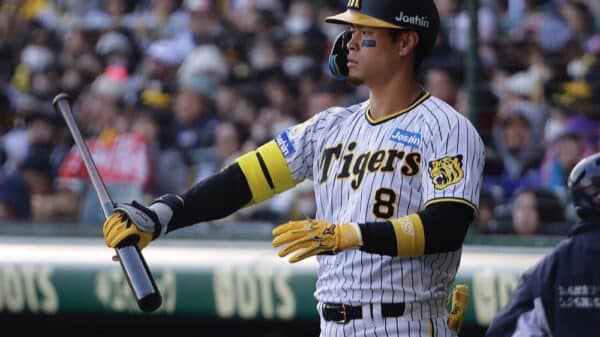
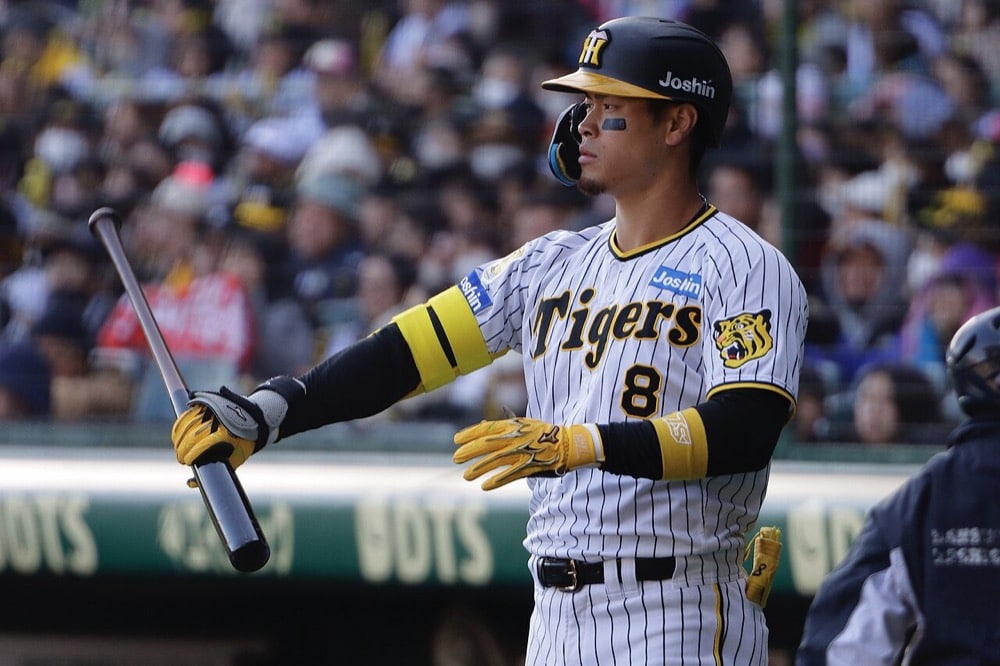
Teruaki Sato enters the market as a legitimate power threat after claiming Japan’s Triple Crown. In 2026, he posted a formidable .306/.383/.609 slash line, anchored by 39 home runs. While he shares similarities with Munetaka Murakami, Sato is a distinct type of hitter. He possesses elite raw power but carries a more aggressive approach that leads to higher strikeout rates and fewer walks.
Statistically, Sato’s 66% contact rate sits well below the MLB average of 77%, raising questions about how his bat will play against high-velocity North American pitching. Defensively, scouts believe his long-term future may lie at first base or a corner outfield spot rather than third base. Despite these risks, his ability to drive the ball out of any park makes him an enticing gamble. The Hanshin Tigers officially made him available for posting on November 1.
2. Kaima Taira, Right-Handed Pitcher (NPB)
Kaima Taira is one of the most intriguing pitching prospects due to his unique physical profile. Standing at 5-foot-8, Taira generates exceptional extension—nearly seven feet—which creates a deceptive, low-release point that keeps hitters off-balance. His arsenal is deep, featuring a mid-90s fastball paired with a diverse mix of cutters, sinkers, sliders, sweepers, splitters, and changeups.
After finding success as a dominant reliever in 2024 and 2025, the Seibu Lions moved him into the rotation in 2026. While his secondary pitches are still developing, many MLB teams view him as a potential starter or a high-leverage, multi-inning relief option. His ability to maintain a starter’s workload given his stature remains the primary question for interested suitors like the Dodgers, Giants, and Padres.
3. Hiroki Itoh, Right-Handed Pitcher (NPB)
Hiroki Itoh is a polished, “crafty” right-hander who previously won the Eiji Sawamura Award, Japan’s version of the Cy Young. Although his 2026 season was slightly less dominant than his 2025 campaign, he still managed a solid 3.18 ERA over 172 2/3 innings. Itoh relies on a seven-pitch mix rather than overwhelming velocity, though he has shown the ability to touch 96 mph in short bursts during international play.
With six consecutive seasons of at least 150 innings pitched, Itoh is viewed as a durable, back-of-the-rotation starter who can provide stability. His versatility also makes him a candidate for a bullpen role if a team prefers his stuff in shorter stints. The Hokkaido Nippon-Ham Fighters officially posted him on November 1.
4. Si-Hwan Roh, Third Base (KBO)
Si-Hwan Roh comes to the MLB market via a landmark agreement with the Hanwha Eagles. After signing the largest contract in KBO history, the Eagles agreed to post the 26-year-old infielder this winter under the condition that he eventually returns to the club to finish his career. Roh is coming off a productive season where he hit .283 with 29 home runs and demonstrated a disciplined eye at the plate.
While his power from the right side is undeniable, there are concerns regarding his contact consistency and his defensive range at third base. However, for a team seeking middle-of-the-order potential, Roh represents the premier offensive talent coming out of South Korea this cycle.
5. Kona Takahashi, Right-Handed Pitcher (NPB)
Unlike the other names on this list, Kona Takahashi is a true international free agent, meaning he is not bound by the restrictive posting windows and can negotiate at his own pace. After failing to find a suitable deal last year, he returned to the Seibu Lions and delivered another strong performance, posting a 2.64 ERA across 148 innings.
Takahashi is a ground-ball specialist who thrives on keeping the ball low in the zone. His fastball sits between 91-95 mph, complemented by an effective splitter and slider. Teams like the Diamondbacks, Rays, and White Sox, who prioritize innings-eaters and ground-ball induction, could see him as a high-value addition to their 2027 rotations.
6. Jyun-Yue Tseng, Right-Handed Pitcher (CPBL)
Jyun-Yue Tseng has established himself as one of the most dominant closers in Taiwan. In 2026, he recorded 25 saves with a 1.80 ERA and an impressive strikeout rate. Tseng features a high-octane fastball that has touched triple digits in the past, though it typically sits in the mid-90s.
His success in the Major Leagues will likely depend on the refinement of his breaking ball. Currently, he is projected as a middle-relief arm with the upside to move into higher-leverage situations if his secondary offerings become more consistent. West Coast teams like the Mariners and Athletics are potential landing spots for the fireballer.
Final Thoughts on the 2027 International Market
The 2027 international free agent class offers a diverse range of talent, from high-upside power hitters like Teruaki Sato to durable, high-IQ pitchers like Hiroki Itoh. While the transition from Asian leagues to MLB always carries a degree of uncertainty regarding velocity adjustments and travel schedules, the recent success of players like Yoshinobu Yamamoto has made MLB front offices more confident than ever in these evaluations. As the December 1 deadline approaches, expect a flurry of activity as teams race to secure these Pacific Rim stars before the winter landscape shifts.